Ultrasound-Guided Stem Cell Injection
Why 30 Million Cells Matter
More Stem Cells Don't Always Mean Better
If you've researched stem cell therapy online, you've probably noticed one recurring theme : cell count.
One clinic advertises 20 million stem cells. Another promotes 50 million. Some even claim to provide more than 100 million, implying that a larger number automatically delivers superior results. It's an understandable assumption. In many areas of life, more seems better. But regenerative medicine doesn't work that way.
When physicians design a stem cell treatment, they aren't simply asking, "How many cells should we use?" They're asking a far more important question :
How can we deliver the right cells to the right place, for the right patient ?
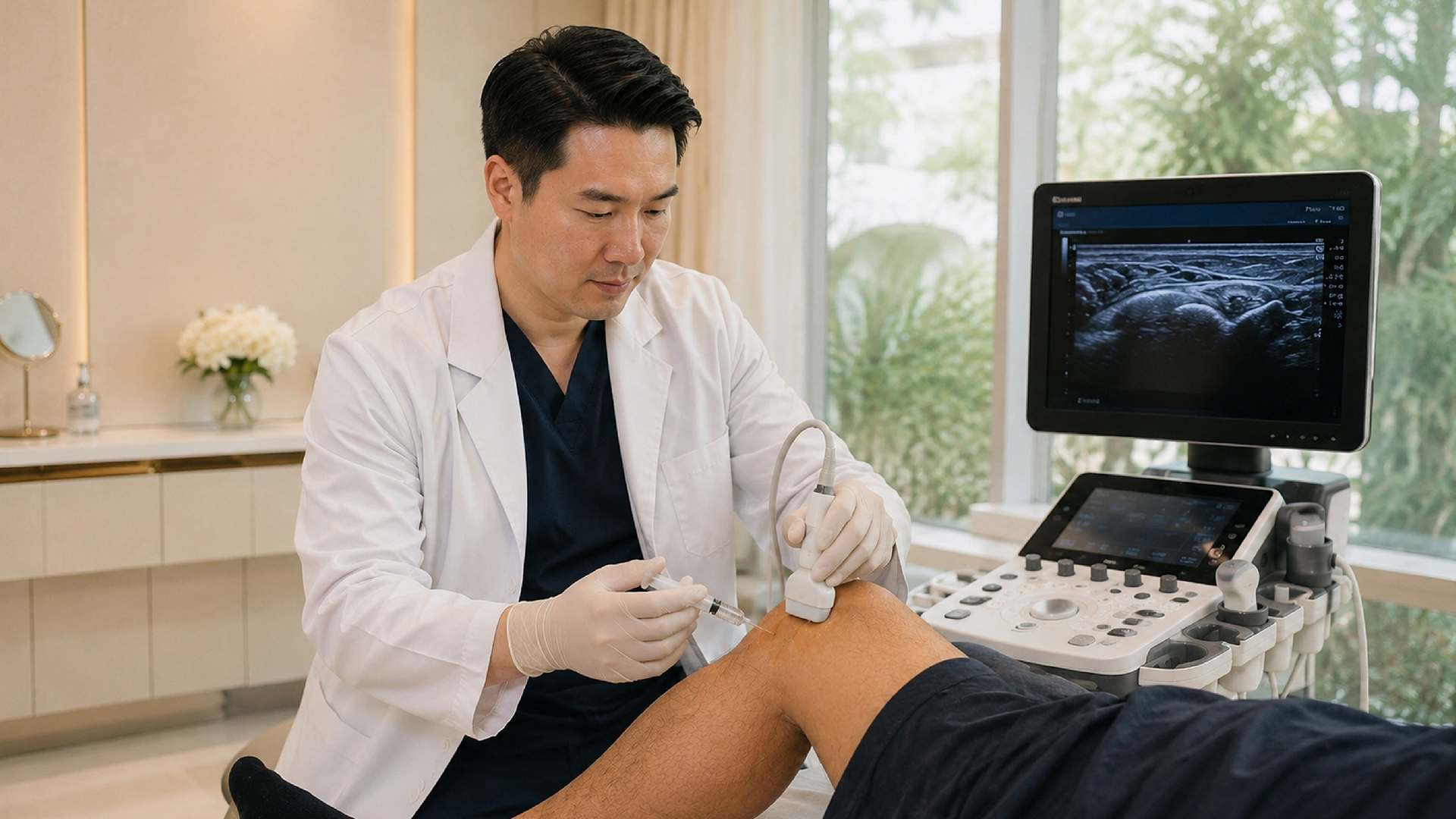
For localized orthopedic and soft tissue conditions, precision often matters more than volume. Delivering stem cells directly into damaged tissue under real-time ultrasound guidance allows physicians to accurately target the area requiring regenerative support, rather than relying on estimation or treating a much larger area than necessary.
This is why Health Passport's 1-Day Local Stem Cell Experience combines 30 million Swedish bone marrow-derived mesenchymal stem cells (MSCs) with physician-performed ultrasound guidance. Instead of pursuing the highest possible cell count, the program focuses on clinical precision, internationally recognized manufacturing standards, and personalized treatment planning.
Understanding why this approach matters begins with understanding how localized regenerative medicine actually works.
Regenerative Medicine Is About Precision, Not Volume
One of the biggest misconceptions surrounding stem cell therapy is that treatment success depends primarily on the number of cells being administered. While cell count certainly plays a role, it represents only one component of a much larger clinical picture.
Imagine trying to repair a small crack in a wall. Simply using more building material doesn't necessarily produce a better repair. What matters is placing the right material exactly where it is needed. The same principle applies to regenerative medicine.
Localized stem cell therapy is designed to support a specific anatomical structure, such as a damaged knee cartilage surface, an injured tendon, or a partially torn ligament. Because the treatment area is relatively small, physicians aim to deliver stem cells precisely to the target tissue rather than distributing them broadly throughout the body.
This is where ultrasound guidance becomes particularly valuable.
Unlike injections performed using anatomical landmarks alone, ultrasound allows physicians to visualize muscles, tendons, ligaments, joints, blood vessels, and surrounding soft tissues in real time throughout the procedure. The needle can be continuously monitored as it advances toward the intended treatment site, helping improve procedural accuracy while avoiding important surrounding structures.
For conditions such as knee osteoarthritis, rotator cuff injuries, tennis elbow, plantar fasciitis, or Achilles tendinopathy, even a small difference in injection placement may influence whether stem cells reach the tissue intended for treatment.
Ultrasound guidance also enables physicians to adapt during the procedure. Every patient's anatomy is slightly different, particularly when degeneration, inflammation, or previous injuries have altered normal tissue appearance. Real-time imaging allows treatment to be individualized rather than relying on standardized injection points.
Another important distinction involves the difference between localized stem cell injection and intravenous stem cell therapy.
Intravenous stem cell therapy is designed for systemic applications, allowing stem cells to circulate throughout the body via the bloodstream. Local injection follows a completely different objective. Instead of supporting multiple organ systems simultaneously, it focuses regenerative therapy on a single anatomical region where precision becomes one of the most valuable aspects of treatment.
For this reason, many experienced regenerative physicians consider imaging guidance to be an important component of localized stem cell procedures. It reflects a philosophy centered on accuracy, personalization, and careful treatment planning rather than simply increasing treatment volume.
Ultimately, regenerative medicine isn't a competition to deliver the highest number of stem cells. It's about delivering the most appropriate treatment with the greatest possible precision.
Why 30 Million Cells Is a Deliberate Clinical Choice
Patients often ask a simple question :
"Why does Health Passport use 30 million stem cells instead of 50 million or 100 million ?"
The answer lies in understanding what localized stem cell therapy is designed to accomplish.
Unlike systemic intravenous treatment, a local injection targets one clearly defined area. Whether treating a knee joint, shoulder tendon, ligament, or another musculoskeletal structure, the physician is working within a relatively small anatomical space. The objective is to create an appropriate concentration of stem cells where regenerative support is needed most.
This is why treatment planning involves more than selecting the highest available cell count.
Physicians also consider the size of the treatment area, the underlying diagnosis, tissue quality, imaging findings, previous treatments, and the patient's overall health. These factors help determine which regenerative approach is most appropriate for each individual.
Equally important is cell viability.
Stem cells are living cells, and their biological integrity depends on careful manufacturing, storage, transportation, and handling before treatment. A well-manufactured, highly viable stem cell product may provide greater regenerative potential than a larger quantity of cells that has experienced reduced quality during production or handling.
Rather than focusing exclusively on quantity, modern regenerative medicine increasingly emphasizes the overall quality of the treatment protocol. This includes manufacturing standards, physician expertise, imaging-guided delivery, and individualized treatment planning.
Health Passport's 30 million bone marrow-derived mesenchymal stem cell protocol reflects this philosophy. It is a carefully considered approach developed for localized regenerative applications, combining high-quality stem cells with physician-performed ultrasound guidance to support accurate treatment delivery.
Instead of asking, "Which clinic offers the most stem cells ?", patients may benefit more from asking :
- How are the stem cells manufactured ?
- Are they produced under recognized pharmaceutical standards ?
- How are they delivered ?
- Is the procedure performed under imaging guidance ?
- Is the treatment personalized for my specific condition ?
These questions often provide a far clearer understanding of treatment quality than cell count alone and help patients make decisions based on clinical considerations rather than marketing numbers.
Quality Over Quantity : The Standard Behind Every Stem Cell
While cell count often dominates marketing headlines, one of the most important questions patients can ask is far simpler :
"Where did these stem cells come from ?"
The origin and manufacturing of stem cells play a fundamental role in regenerative medicine. Regardless of how many cells are administered, their quality depends on how they were collected, processed, expanded, tested, stored, and transported before they ever reach the treatment room.
Stem cells are living biological products, not manufactured pharmaceuticals. Their viability, consistency, and purity can all be influenced by the production process. This is why internationally recognized manufacturing standards are considered an important component of modern regenerative medicine.
At Health Passport, we utilize bone marrow-derived mesenchymal stem cells (MSCs) manufactured in a Swedish EU-GMP Grade A/B pharmaceutical facility. Every batch is produced under strict quality control procedures designed to maintain consistency throughout the manufacturing process.
Each stem cell preparation is accompanied by a Certificate of Analysis (CoA), documenting the quality testing performed before clinical release. Every production batch is also certified by a Swedish Qualified Person (QP), an independent pharmaceutical professional responsible for verifying that each batch meets European manufacturing requirements.
Another important consideration is the cell culture process itself.
Health Passport's stem cells are manufactured using animal-component-free culture conditions, helping maintain consistency throughout expansion while eliminating the use of animal-derived ingredients during production. This reflects modern pharmaceutical manufacturing practices adopted by many advanced regenerative medicine laboratories.
However, manufacturing quality represents only one part of the equation.
Successful regenerative medicine also depends on selecting the appropriate treatment for each patient. Before recommending stem cell therapy, physicians evaluate your diagnosis, imaging studies, medical history, lifestyle, previous treatments, and overall health objectives. These factors help determine whether localized stem cell injection is appropriate or whether another regenerative approach may better suit your needs.
This individualized planning distinguishes evidence-informed regenerative medicine from standardized treatment packages. Rather than applying the same protocol to every patient, physicians build treatment strategies around each person's unique clinical situation.
Ultimately, the value of stem cell therapy cannot be measured by cell count alone. Quality manufacturing, physician expertise, accurate treatment delivery, and personalized medical planning all contribute to a regenerative program designed with precision rather than volume in mind.
The Bottom Line
Stem cell therapy has opened exciting new possibilities within regenerative medicine, but understanding what truly matters requires looking beyond the numbers.
While higher cell counts often attract attention, successful localized stem cell therapy depends on a combination of carefully selected factors working together. The quality of the stem cells, the expertise of the treating physician, the precision of ultrasound-guided delivery, and a personalized treatment strategy all contribute to creating an approach tailored to the individual rather than following a one-size-fits-all model.
For localized orthopedic and soft tissue conditions, precision is often the defining principle. Delivering stem cells directly to the intended treatment site allows physicians to focus regenerative support where it is needed most, while internationally recognized manufacturing standards help ensure the integrity and consistency of the cells being administered.
As regenerative medicine continues to evolve, patients are becoming more informed than ever before. Instead of asking only "How many stem cells ?", many are beginning to ask more meaningful questions :
- How are the stem cells manufactured ?
- Are internationally recognized quality standards followed ?
- Is the treatment personalized for my condition ?
- Will imaging guidance be used ?
- Is the recommendation based on my diagnosis rather than a standardized protocol ?
These questions often provide a far clearer picture of treatment quality than cell count alone.
Ultimately, regenerative medicine is about delivering the right cells, to the right location, for the right patient, at the right time. Understanding this broader perspective allows patients to make confident, well-informed decisions based on clinical quality rather than marketing claims alone.
.png)
.png)

Turn Insight Into Action
The knowledge you've gained today is only the beginning.
Explore our physician-led programs and discover a personalized path
toward better health, greater vitality and lasting longevity.
The knowledge you've gained today is only the beginning. Explore our physician-led programs and discover a personalized path toward better health, greater vitality and lasting longevity.

Local Stem Cell Experience
A focused 1-day ultrasound-guided Local Stem Cell Injection delivering 30 million cells with millimeter precision to a single target site. Includes VIP hotel transfer, Fast Track immigration, unlimited IV therapy, plus complimentary Advanced PRP and BPC-157 peptide recovery support.
361,250 THB / ~10,625 USD
425,000 THB / ~12,500 USD
.avif)
Longevity Vitality Program
A 100-million-cell premium Stem Cell IV infusion with DFPP advanced blood detox, Placenta therapy, Hyperbaric Oxygen Therapy and Unlimited premium NAD+ IV, complemented by a four-night stay at your choice of Dusit Thani, The Ritz-Carlton or Grande Centre Point Terminal 21.
1,676,200 THB / ~49,300 USD
1,972,000 THB / ~58,000 USD
.avif)
An integrative executive health screening combining comprehensive diagnostics, CT scanning and unlimited IV therapy, paired with a two-night stay at Anantara Riverside Bangkok Resort. A data-driven foundation for every regenerative wellness journey.
274,550 THB / ~8,075 USD
323,000 THB / ~9,500 USD
.avif)
A 5-day precision healthspan experience decoding your genetics, epigenetics and microbiome, paired with 10 sessions of Hyperbaric Oxygen Therapy and EECP cardiovascular rejuvenation, 3-month hormone replacement and Unlimited IV.
722,500 THB / ~21,250 USD
850,000 THB / ~25,000 USD

Begin Your Journey to Lasting Vitality
Complete the confidential enquiry form and a dedicated concierge will
personally assist in tailoring your journey, discreetly and without obligation.
Complete the confidential enquiry form and a dedicated concierge will personally assist in tailoring your journey, discreetly and without obligation.
A dedicated Health Passport concierge will be in touch shortly to guide you through the next steps.