DFPP and Stem Cell Therapy: Clinical Roles and Treatment Sequence

When evaluating advanced regenerative medicine options, patients frequently encounter both DFPP (double filtration plasmapheresis) and stem cell therapy. These are clinically distinct procedures that perform entirely different functions within the body. They are not competing options or interchangeable treatments. Instead, they serve complementary roles within a comprehensive, physician-designed medical protocol.
For high-net-worth individuals and international executives researching stem cell therapy programs in Bangkok, understanding the mechanics behind these treatments provides clarity on why doctors prescribe them. The relationship between DFPP and stem cell therapy is built on sequential preparation and administration. In many luxury medical programs, DFPP may be performed first to prepare the circulating blood environment before an intravenous infusion of mesenchymal stem cells (MSCs) takes place.
Why DFPP and Stem Cell Therapy Are Not Mutually Exclusive
To understand why these treatments often appear together in luxury healthcare programs, patients must look at their fundamental direction of action. The two procedures operate in opposite directions. DFPP removes selected components from the circulating plasma. Stem cell therapy administers living, biologically active cells into the patient.
Because their mechanisms and clinical purposes differ so distinctly, a physician may recommend either procedure independently or sequence them together. The final recommendation relies entirely on the patient's specific health profile, laboratory findings, and personal treatment goals.
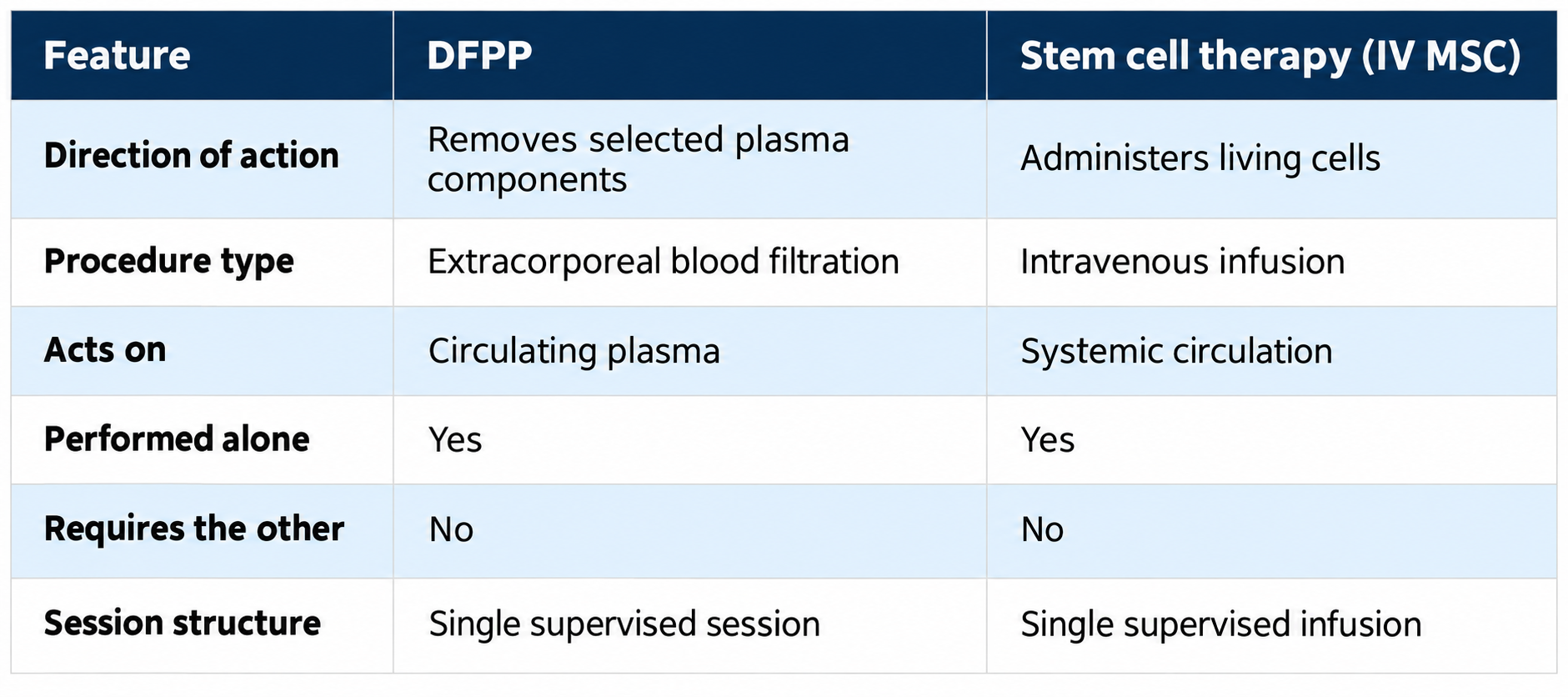
The fundamental differences outlined above explain why a medical team does not view these treatments as mutually exclusive. By applying a removal process followed by an administration process, physicians can address different aspects of a patient's systemic health during a single visit to Bangkok.
The Clinical Role of DFPP (Double Filtration Plasmapheresis)
DFPP is an extracorporeal procedure designed to separate plasma from blood cells and filter selected plasma components before returning the processed blood to the patient. It relies on advanced cascade filtration technology. Medical professionals do not present double filtration plasmapheresis (DFPP) as a universal detoxification cure. Its application is highly specific.
Filtration targets, patient suitability, and expected physiological changes all depend entirely on the prescribed clinical protocol. Physicians program the secondary fractionator to target molecules of specific weights, such as large lipoproteins or circulating immune complexes, while retaining essential proteins like albumin.
What Happens During a DFPP Procedure
The procedure begins with a gentle blood withdrawal, typically from a vein in the arm. The blood flows into a primary plasma separator, which divides the cellular components (red blood cells, white blood cells, and platelets) from the plasma. The plasma then moves through a secondary selective fractionator. This highly engineered filter captures specific large molecular weight components based on the physician's settings.
Finally, the filtered plasma reunites with the cellular components and returns to the patient's circulation in a continuous loop. The entire session requires strict clinical monitoring by specialized nurses and attending physicians. Because hemodynamic shifts can occur, medical staff conduct an individualized assessment of potential risks and contraindications prior to initiating the filtration.
What DFPP Is Intended to Do Before Cell Administration
In a combined clinical protocol, DFPP acts as a preparatory step. It is intended to reduce selected unwanted circulating plasma components before systemic MSC administration. By filtering the plasma first, the physician aims to alter the intravascular microenvironment that the incoming stem cells will encounter.
It is important to note that this biological rationale does not prove DFPP will improve stem cell outcomes for every patient. Individual responses vary widely based on baseline health, the specific molecules filtered, and the quality of the stem cells administered. The intention is simply to optimize the circulatory environment according to the prescribed protocol.
How the DFPP and Stem Cell Treatment Sequence Works
At Health Passport Bangkok, combining these procedures requires strict adherence to a medically supervised timeline. This specific sequence reflects the program's unique clinical design and should not be interpreted as a universal standard for every patient or provider globally. The exact timing and integration depend heavily on the individual's baseline diagnostics.
Step 1: Physician Consultation and Baseline Assessment
Before any procedure begins, the patient undergoes a rigorous baseline assessment. The attending physician reviews the patient's medical history, current conditions, active medications, treatment goals, and comprehensive laboratory findings. This thorough evaluation helps the physician decide whether DFPP, MSC therapy, or a combined protocol should be considered. Blood panels, biomarker analysis, and physical examinations form the foundation of this personalized medical decision.
Step 2: DFPP Plasma Filtration
If the patient is deemed suitable for the combined approach, DFPP is performed first. The clinical team programs the filtration unit to filter selected unwanted plasma components according to the prescribed protocol. The patient rests in a private, medically equipped luxury suite while the extracorporeal circuit processes the blood. The medical team monitors the patient's vital signs, hydration status, and clinical condition continuously throughout the procedure. This foundational step is a core component of the comprehensive Longevity Vitality Program.
Step 3: Intravenous MSC Administration
Following the successful completion of the plasma filtration, the patient receives the stem cell infusion. Within the Longevity Vitality Program, this involves administering 100 million bone marrow-derived MSCs intravenously. The clinic prioritizes exceptional pharmaceutical standards. Every stem cell vial is cultured in an EU-GMP Grade A/B facility in Stockholm, Sweden.
Patients receive documented proof of verified cell identity, viability, sterility, and traceability through a Certificate of Analysis (CoA). A Swedish Qualified Person (QP) independently certifies the batch. A physician directly supervises the entire intravenous administration to ensure absolute safety and comfort.
Step 4: Recovery and Physician Follow-Up
The final step involves post-procedure observation and supportive care. Patients rest in their private suites while medical staff monitor for any immediate reactions. Before the patient returns to their five-star accommodation, the attending physician conducts a thorough review.
The doctor provides individualized follow-up recommendations regarding hydration, nutrition, and physical activity. Recovery experiences and clinical outcomes can vary significantly between patients. The medical team remains available for follow-up consultations to discuss long-term lifestyle integrations and track biomarker progress.
When a Combined Protocol May Be Considered
A sequential DFPP and MSC protocol may be considered when both plasma filtration and systemic cell administration align seamlessly with the patient's clinical objectives. This is not a standard package applied blindly to every visitor. The decision to combine these sophisticated modalities requires deep clinical justification.
The attending physician must account for baseline biomarkers, a detailed medical history, potential contraindications, and any concurrent treatments. For example, an executive presenting with specific inflammatory markers and a desire for systemic regenerative support might be an appropriate candidate. Ultimately, suitability is determined entirely by physician assessment.
Who Should Not Undergo DFPP or MSC Therapy
Because these are advanced medical interventions, they are not suitable for everyone. Eligibility requires strict physician assessment rather than a simple self-screening checklist. There are general contraindications and specific cautions associated with both extracorporeal filtration and living cell administration.
Patients with active infections, severe cardiovascular instability, bleeding disorders, or compromised venous access may face restrictions regarding DFPP. The procedure requires a stable hemodynamic baseline. Those taking specific anticoagulant medications must undergo careful review to prevent complications during the continuous blood withdrawal and return cycle.
For intravenous MSC administration, physicians exercise caution with patients who have a history of active malignancies, certain autoimmune conditions in acute flare states, or severe immunodeficiency. Interactions with current immunosuppressive medications or recent biological therapies also require deep evaluation. Based on these complex variables, a physician may recommend MSC therapy alone, DFPP alone, or advise against both procedures entirely to protect the patient's well-being.
How Much Does DFPP and Stem Cell Therapy Cost in Bangkok?
Financial transparency is a cornerstone of luxury healthcare. In the context of Health Passport Bangkok's premium offerings, DFPP is not priced as a standalone add-on. Instead, it is fully integrated into the comprehensive Longevity Vitality Program alongside the 100 million-cell MSC infusion and other advanced modalities.
Comparing the primary regenerative programs allows international patients to see exactly what the higher tier provides in terms of clinical value and luxury accommodation.
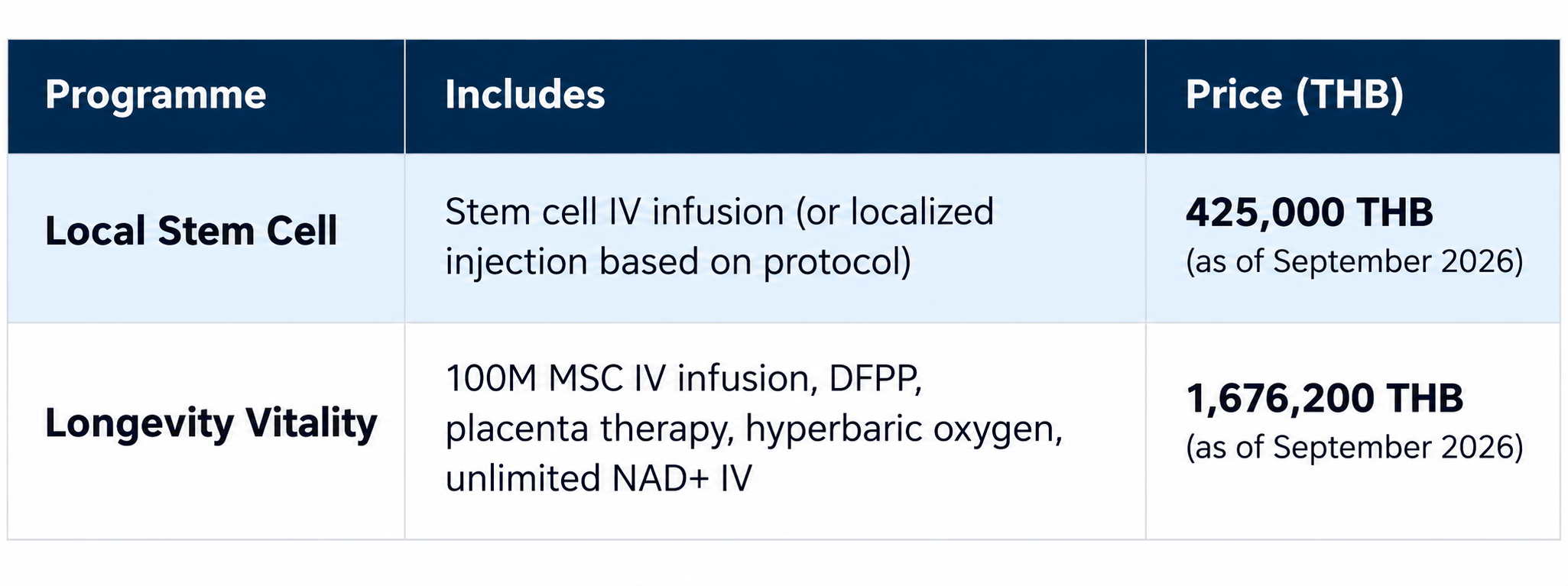
Prices are subject to change. The figures above reflect discounted program rates available at the time of writing. Always confirm current pricing and specific inclusions during your official medical consultation.
Frequently Asked Questions
1. Is DFPP required before stem cell therapy?
No, DFPP is not a mandatory requirement before receiving stem cell therapy. A physician may consider a combined protocol if blood diagnostics suggest that filtering selected plasma components aligns with your clinical objectives. Many patients successfully receive intravenous stem cells without undergoing prior plasma filtration.
2. Can I have stem cell therapy without DFPP?
Yes, you can absolutely undergo stem cell therapy as a standalone treatment. The decision to proceed with living cell administration alone depends on your baseline health, systemic goals, and the medical protocol designed by your attending physician.
3. How long does a DFPP session take?
A typical DFPP session generally lasts between two to three hours, depending on the prescribed filtration volume and your individual blood flow rates. Patients spend this time resting comfortably in a private, medically monitored treatment suite while the extracorporeal circuit processes the plasma.
4. Is DFPP safe?
DFPP is a highly regulated medical procedure that is generally safe when performed by experienced clinical staff on properly screened patients. Continuous monitoring tracks vital signs and hemodynamic stability, but as with any blood processing treatment, potential risks exist and must be evaluated during your initial consultation.
5. Is DFPP included in the Longevity Vitality Program cost?
Yes, DFPP is fully included in the total cost of the Longevity Vitality Program. It is packaged alongside the 100 million-cell MSC infusion, specialized oxygen therapies, premium intravenous support, and a luxury hotel stay, offering a seamless and comprehensive medical experience.
6. How soon after DFPP is the MSC infusion given?
The MSC infusion is typically administered shortly after the completion of the DFPP session, often on the same day or following a brief recovery period. The exact timing is strictly dictated by your physician's personalized protocol to ensure optimal safety and clinical effectiveness.
Speak With a Physician About Your Protocol
Determining the appropriate sequence of advanced medical treatments requires professional medical insight. Suitability for either plasma filtration or systemic cell administration is decided solely by comprehensive clinical assessment rather than by patient preference alone. To explore how these protocols might align with your specific health objectives, we invite you to book a consultation with our specialized medical team in Bangkok today.


.png)
Turn Insight Into Action
The knowledge you've gained today is only the beginning.
Explore our physician-led programs and discover a personalized path
toward better health, greater vitality and lasting longevity.
The knowledge you've gained today is only the beginning. Explore our physician-led programs and discover a personalized path toward better health, greater vitality and lasting longevity.
Local Stem Cell Experience
A focused 1-day ultrasound-guided Local Stem Cell Injection delivering 30 million cells with millimeter precision to a single target site. Includes VIP hotel transfer, Fast Track immigration, unlimited IV therapy, plus complimentary Advanced PRP and BPC-157 peptide recovery support.
361,250 THB / ~10,625 USD
425,000 THB / ~12,500 USD
.avif)
Longevity Vitality Program
A 100-million-cell premium Stem Cell IV infusion with DFPP advanced blood detox, Placenta therapy, Hyperbaric Oxygen Therapy and Unlimited premium NAD+ IV, complemented by a four-night stay at your choice of Dusit Thani, The Ritz-Carlton or Grande Centre Point Terminal 21.
1,676,200 THB / ~49,300 USD
1,972,000 THB / ~58,000 USD
.avif)
An integrative executive health screening combining comprehensive diagnostics, CT scanning and unlimited IV therapy, paired with a two-night stay at Anantara Riverside Bangkok Resort. A data-driven foundation for every regenerative wellness journey.
274,550 THB / ~8,075 USD
323,000 THB / ~9,500 USD
.avif)
A 5-day precision healthspan experience decoding your genetics, epigenetics and microbiome, paired with 10 sessions of Hyperbaric Oxygen Therapy and EECP cardiovascular rejuvenation, 3-month hormone replacement and Unlimited IV.
722,500 THB / ~21,250 USD
850,000 THB / ~25,000 USD

Begin Your Journey to Lasting Vitality
Complete the confidential enquiry form and a dedicated concierge will
personally assist in tailoring your journey, discreetly and without obligation.
Complete the confidential enquiry form and a dedicated concierge will personally assist in tailoring your journey, discreetly and without obligation.
A dedicated Health Passport concierge will be in touch shortly to guide you through the next steps.